


Japan's impact on Mississippi takes center stage with 18,000 jobs
Japan's impact on Mississippi takes center stage with 18,000 jobs

Ross Reily, Mississippi Clarion LedgerSat, October 3, 2026 at 9:59 AM UTC
0
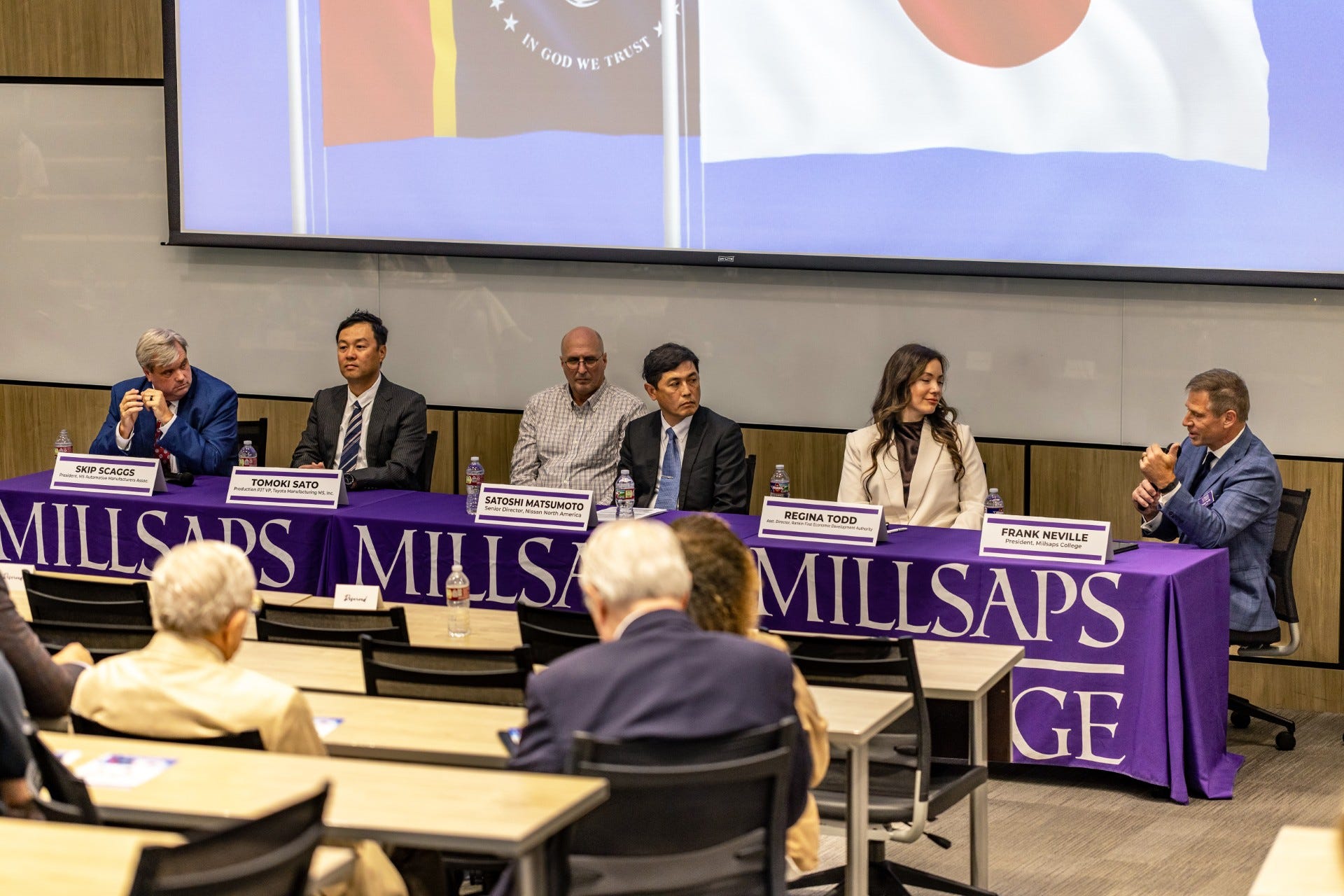
The relationship between the United States, in particular Mississippi, and Japan remains one of the world's most important international partnerships.
That was the message as more than 100 business leaders, educators, economic developers, students and community members gathered at Millsaps College on Sept. 29 for a roundtable discussion examining the future of U.S.-Japan relations and the role those ties continue to play in Mississippi's economy.
The event, "Partners in Progress: The Present & Future of Japan-U.S. Relations," was hosted by Millsaps in partnership with the Consulate General of Japan in Nashville and the Japan-America Society of Mississippi. The discussion was held in McMullan Lecture Hall and was followed by a cultural performance.
Panelists included Shinji Watanabe, consul general of Japan in Nashville; Regina Todd, assistant director of the Rankin First Economic Development Authority; Satoshi Matsumoto, senior director at Nissan North America; Tomoki Sato, production project vice president at Toyota Mississippi; Skip Skaggs, president of the Mississippi Automotive Manufacturers Association; and Millsaps College President Frank Neville.
Japan-U.S. partnership remains strong
Watanabe said the relationship between the United States and Japan remains one of the world's most important international partnerships.
"Our office covers five states, including Mississippi," Watanabe said. "I had the opportunity to visit Mississippi from time to time, and it's always a great pleasure to be here."
Watanabe pointed to recent high-level discussions between Japanese and U.S. leaders as evidence of continued cooperation across economic, security and technology issues.
He said both countries are navigating a period of rapid change driven by artificial intelligence, emerging technologies and evolving global security concerns, making international partnerships increasingly important.
Japan has long been one of Mississippi's most important international economic partners, with Japanese companies helping anchor the state's manufacturing base and supporting thousands of jobs.
Major Japanese investments include Nissan North America's assembly plant in Canton, which employs thousands of workers and produces vehicles for domestic and international markets; Toyota Mississippi's Blue Springs facility, which manufactures the Corolla; and Yokohama Tire Manufacturing Mississippi in West Point, one of the largest tire plants in the nation. Hitachi Energy's transformer manufacturing operations in Crystal Springs further underscore Japan's long-standing investment and growing industrial presence in Mississippi.
Japanese suppliers and manufacturers are also part of Mississippi's automotive supply chain, making Japan a key driver of the state's manufacturing economy, export activity and workforce development efforts. Business leaders at the Millsaps forum noted that the relationship extends beyond trade, with decades of investment helping establish Mississippi as a major automotive manufacturing hub in the Southeast.
"The Japan-U.S. relationship is stronger than ever," Watanabe said.
On the economic front, he noted that Japan has remained one of the largest foreign investors in the United States, with Japanese companies supporting nearly 1 million American jobs and continuing to expand investments in strategic industries.
Watanabe highlighted recent commitments aimed at increasing Japanese investment in sectors such as energy, infrastructure and critical materials.
"We are already seeing positive results from this relationship," Watanabe said. "The strong Japan-U.S. relationship has stood the test of time."
Shared values underpin alliance
Neville said the close relationship between the United States and Japan has endured since World War II because both nations share common goals centered on economic prosperity and stability.
"Since the postwar era, the United States and Japan have had a very close and lasting relationship because they share a couple of key values," Neville said. "One is a desire for prosperity and investment that drives growth in both countries. There's also a desire for regional and international security that helps protect and promote that prosperity."
Advertisement
Those shared priorities have helped sustain the alliance through decades of political and economic change, Neville said.
At the same time, Neville argued that the world is entering a new era marked by uncertainty as longstanding geopolitical structures evolve.
"I think what we're seeing right now in the world is the natural ending of the old order, and there's a lot of uncertainty around what comes next," Neville said.
Neville described the post-World War II international system as one in which the United States provided stability through security partnerships, freedom of navigation and a rules-based economic framework that encouraged trade and investment.
"The global order that has provided the context for that relationship is changing," Neville said. "We have a very strong foundation for the relationship, but we're now entering somewhat uncharted waters because the global order that has sustained it is evolving."
Automotive industry's impact highlighted
The discussion also focused on the significant role Japanese investment has played in Mississippi's automotive sector.
Skaggs said the industry employs more than 18,000 Mississippians and generates an estimated $21 billion in annual economic activity.
"When you look at the automotive industry in Mississippi, you're looking at more than 18,000 Mississippians working in the industry," Skaggs said. "It's about a $21 billion-a-year industry."
Skaggs said automotive manufacturing produces one of the strongest economic multiplier effects of any industry in the state.
"For every automotive job, you're creating multiple additional jobs," Skaggs said. "That's one of the highest multiplier factors for job creation."
Skaggs said continued investments in workforce development and new technologies will be critical to maintaining Mississippi's competitiveness in the global market.
"The important part is this industry continues investing in workforce growth and technology that allows us to do more and remain competitive," Skaggs said.
Economic ties remain important for Mississippi
Throughout the discussion, panelists emphasized the importance of Japanese investment to Mississippi's economy, particularly through the state's automotive manufacturing sector and related supply chains.
Speakers discussed how changes in global trade, advanced manufacturing and emerging technologies are reshaping economic development strategies while creating new opportunities for collaboration between Mississippi and Japan.
Organizers said the forum was designed to strengthen cultural and economic ties while underscoring Japan's continued importance as one of Mississippi's key international business partners.
Ross Reily is a writer for the Clarion Ledger, part of the USA TODAY Network. He can be reached at rreily@gannett.com or 601-573-2952. You can follow him on the X platform, formerly known as Twitter @GreenOkra1.
This article originally appeared on Mississippi Clarion Ledger: Japan's impact on Mississippi takes center stage with 18,000 jobs
Source: “AOL Money”
